

Finding more hair than usual on your pillow, comb, shower floor, or clothes can be unsettling. If you’ve recently started asking “why is my hair falling out?”, you’re certainly not alone.
Some daily hair shedding is completely normal. The American Academy of Dermatology (AAD) says people commonly shed around 50 to 100 hairs a day as part of the normal hair-growth cycle. The concern is when shedding becomes noticeably heavier or when you begin seeing thinning, a widening part, a receding hairline, or bald patches.
Hair fall doesn’t have one universal cause. Genetics, recent illness, significant stress, rapid weight loss, nutritional problems, medications, hormonal conditions, tight hairstyles, scalp disorders, and certain immune-related conditions can all play a role.
The important part is understanding what kind of hair loss you are experiencing.
This guide explains the difference between normal shedding and hair loss, explores 10 common causes, and gives you practical steps that can help you decide what to do next.
Health Disclaimer: This article is for general health education only. Hair loss can have many causes, and persistent, sudden, patchy, or unexplained hair loss should be evaluated by a qualified healthcare professional.
Is Hair Shedding Always a Sign of Hair Loss?
No.
Your hair is constantly going through a cycle of growth, rest, and shedding. Older hairs eventually fall out so that new hairs can grow.
That means seeing some hair in your brush or shower isn’t automatically a sign of baldness.
The AAD distinguishes between ordinary shedding and excessive shedding. Excessive shedding is sometimes called telogen effluvium and can occur after a major physical or emotional stressor.
Normal shedding may look like:
- A small amount of hair on your brush
- Some strands in the shower
- A few hairs on your pillow
- No obvious reduction in overall hair density
Hair loss may look more like:
- A widening part
- A receding hairline
- Thinning around the crown
- Noticeable reduction in overall density
- Round or irregular bald patches
- Eyebrow or eyelash loss
If your hair looks progressively thinner rather than simply shedding occasionally, it is worth paying attention to the pattern.
10 Common Reasons Why Your Hair May Be Falling Out
1. Hereditary Hair Loss
One of the most common explanations for gradual hair thinning is hereditary hair loss, also known as androgenetic alopecia.
It can affect both men and women. The AAD identifies hereditary hair loss as the most common cause of hair loss worldwide.
The pattern can be different between individuals.
In men, you may notice:
- Receding temples
- A changing hairline
- Thinning around the crown
- Gradual progression over time
In women, you may notice:
- A widening middle part
- Thinning across the top of the scalp
- Gradually reduced hair density
Genetic hair loss can sometimes begin relatively early. In men, the AAD notes that male-pattern hair loss can begin during the late teenage years or twenties.
So if close relatives experienced early thinning, genetics may be an important part of the explanation.
2. Stress Can Trigger Excessive Hair Shedding
If you’re wondering why is my hair falling out suddenly, think about what your body has experienced during the previous few months—not just the previous few days.
Major physical or emotional stress can trigger excessive shedding.
Possible triggers include:
- A serious illness
- High fever
- Surgery
- Major emotional stress
- Significant weight loss
- Childbirth
- Recovery from an illness
One interesting feature of stress-related shedding is the delay.
The AAD explains that people may notice excessive shedding a few months after the triggering event.
For example, imagine you had a high fever in January and recovered completely. If you notice considerably more hair falling out in March, the earlier illness could potentially be relevant.
This type of shedding can be temporary. The AAD notes that once the body readjusts, excessive shedding often stops and hair can gradually regain normal fullness.
If stress is a major part of your daily routine, our Stress Management guide may also be useful.
3. Rapid Weight Loss or Crash Dieting
A dramatic change in your diet can affect your hair.
Very restrictive diets, significant calorie reduction, and rapid weight loss may trigger increased shedding. MedlinePlus lists low-protein diets, poor nutrition, and crash dieting among possible contributors to hair loss.
This is one reason extreme “quick weight-loss” plans can have consequences beyond the number on the scale.
Instead of dramatically cutting food, focus on a sustainable eating pattern that provides:
- Adequate calories
- Protein
- Fruits and vegetables
- Whole grains
- Legumes
- Healthy fats
- A variety of vitamins and minerals
Our Balanced Diet guide explains how to build a more balanced eating pattern.
4. Nutritional Deficiencies
Hair follicles require nutrients to function normally.
Insufficient intake of certain nutrients can contribute to hair loss, particularly when someone has a restrictive diet or another condition affecting nutrition.
Iron and protein are among the nutritional factors that may be considered when evaluating hair loss. The AAD specifically advises people not to assume they need hair-growth supplements without first determining whether they actually have a deficiency.
This is important because:
Hair fall does not automatically mean vitamin deficiency.
Taking random supplements based solely on social-media advice may not solve the underlying problem.
In some cases, excessive intake of certain nutrients can actually contribute to hair loss.
If you have persistent hair loss along with other symptoms or risk factors for nutritional deficiency, a healthcare professional can determine whether testing is appropriate.
5. Thyroid and Other Hormonal Problems
Hormonal changes can affect hair growth.
Thyroid disorders are one example. MedlinePlus lists thyroid disease among possible causes of hair loss.
Depending on the condition, someone may also experience symptoms such as:
- Unusual tiredness
- Weight changes
- Temperature sensitivity
- Changes in heart rate
- Skin changes
- Menstrual changes
But there is an important distinction:
Hair loss alone does not mean you have a thyroid problem.
If hair thinning appears together with several unexplained symptoms, discussing the combination with a healthcare professional is more useful than trying to treat the hair itself with supplements.
6. Recent Illness, High Fever, or Surgery
Your body sometimes responds to a major physical event by temporarily changing the hair-growth cycle.
A high fever, significant illness, major surgery, or other physical stress can be followed by increased hair shedding.
This can be confusing because the illness may have happened months before you notice the hair fall.
A simple timeline
January: High fever
↓
February: Recovery
↓
March: Noticeably more hair shedding
↓
Following months: Shedding gradually settles
This pattern can occur with telogen effluvium.
It doesn’t prove that your previous illness caused the shedding, but the timing is useful information to tell a healthcare professional.
7. Pregnancy and Postpartum Changes
Pregnancy and the months following childbirth can produce noticeable changes in hair shedding.
The AAD lists childbirth among events that can trigger excessive shedding.
Some women notice that their hair looks particularly thick during pregnancy and then experience substantial shedding afterward.
This can feel alarming, but postpartum shedding is often temporary.
If you’re experiencing significant hair loss after childbirth, especially if it is severe or persistent, discussing it with a healthcare professional can help distinguish normal postpartum shedding from another condition.
8. Tight Hairstyles and Hair Damage
Sometimes the problem isn’t what’s happening inside your body—it’s what’s happening to the hair itself.
Repeated tension can contribute to traction alopecia, a form of hair loss associated with hairstyles that continuously pull on the follicles.
Examples include:
- Very tight ponytails
- Tight braids
- Tight buns
- Certain extensions
- Repeated pulling in the same area
If a hairstyle causes pain, tenderness, or a strong pulling sensation, that’s a useful warning sign.
The AAD also recommends gentle handling of hair and avoiding unnecessary tugging or aggressive brushing.
9. Heat, Chemicals, and Excessive Hair Processing
Hair can become fragile from repeated chemical or physical damage.
Frequent:
- Bleaching
- Straightening
- Perming
- Relaxing
- High-heat styling
- Aggressive brushing
can contribute to hair damage and breakage.
The AAD notes that coloring, perming, relaxing, and other damaging hair-care practices can contribute to hair loss or damage.
It’s useful to distinguish breakage from shedding.
Breakage
The hair shaft snaps, leaving shorter pieces.
Shedding
The complete hair leaves the follicle.
A person can experience both at the same time.
If your hair is becoming shorter, rougher, or more fragile while also appearing thinner, excessive styling may be part of the problem.
10. Scalp Conditions, Alopecia Areata, or Certain Medicines
Some types of hair loss are related to medical conditions affecting the scalp, immune system, or hair follicles.
For example, alopecia areata can cause clearly defined bald patches. Other scalp conditions, including fungal infections, can also result in hair loss.
Certain medicines and medical treatments can also cause hair loss. MedlinePlus lists medications and cancer treatments among possible causes.
If you suspect a medication is causing your hair loss, don’t stop taking it on your own.
Speak with the healthcare professional who prescribed it.

Why Is My Hair Falling Out More Than Usual?
If you’re noticing much more hair than normal, don’t immediately assume you’re going bald.
Instead, look at the bigger picture.
Ask yourself:
What happened during the last 2–4 months?
- Did I have a high fever?
- Was I seriously ill?
- Did I have surgery?
- Did I lose weight quickly?
- Did I drastically change my diet?
- Have I been under unusual stress?
- Did I give birth recently?
- Did I start a new medicine?
- Have I changed my hairstyle?
- Have I increased chemical or heat treatments?
This simple timeline can provide surprisingly useful information.
Hair Fall in Men vs. Women
Hair loss doesn’t look exactly the same in everyone.
Common pattern in men
Hereditary hair loss often starts around the temples or hairline and may later involve the crown.
Common pattern in women
Hereditary hair loss more commonly causes overall thinning around the top of the scalp and a widening central part.
However, these are patterns—not diagnostic rules.
Stress-related shedding, nutritional problems, medical conditions, medications, and other causes can affect either sex.
What Can You Do About Hair Fall?
There isn’t one treatment that works for every type of hair loss. The most useful approach is to identify the underlying cause.
1. Eat Enough and Eat Well
Avoid extreme dieting.
Build meals around a variety of:
- Protein-rich foods
- Vegetables
- Fruits
- Whole grains
- Beans and lentils
- Nuts and seeds
- Other nutrient-rich foods
2. Get Enough Protein
Very low protein intake can contribute to hair loss.
Rather than looking for a single “best food for hair,” aim for adequate protein as part of an overall balanced diet.
3. Avoid Crash Diets
Rapid weight loss can be followed by excessive hair shedding.
If you’re trying to lose weight, gradual and sustainable changes are generally more practical than severe calorie restriction.
4. Treat Your Hair Gently
Try to:
- Use gentle shampooing
- Condition regularly
- Comb carefully
- Avoid aggressive brushing
- Reduce excessive heat
- Avoid very tight hairstyles
- Take breaks from extensions if they pull on your scalp
The AAD recommends gentle hair care and minimizing practices that can damage fragile hair.
5. Manage Ongoing Stress
Stress management isn’t a magic hair-growth treatment, but reducing major ongoing stress can support overall health and may be relevant when stress is contributing to excessive shedding.
Regular physical activity and healthy sleep can also support general well-being.
You can read our Healthy Sleep guide for practical sleep habits.
Should You Take Hair Growth Supplements?
Be careful.
Hair supplements are heavily marketed, but more vitamins do not automatically mean more hair.
The AAD warns that excessive amounts of certain nutrients—including selenium, vitamin A, and vitamin E—have been associated with hair loss. It recommends determining whether a deficiency exists before taking supplements for hair growth.
Biotin is another common example.
Biotin supplements are widely marketed for hair growth, but biotin deficiency is uncommon, and evidence for routine supplementation in people without deficiency is limited. High-dose biotin can also interfere with certain laboratory tests.
So before buying an expensive “hair vitamin,” consider asking:
Do I actually have a deficiency?
If you don’t know, a healthcare professional can help determine whether testing is appropriate.
Can Hair Fall Grow Back?
Sometimes.
It depends on the cause.
Temporary shedding after illness, surgery, childbirth, significant stress, or major weight loss may improve when the underlying trigger resolves.
Other forms, such as hereditary hair loss, may continue gradually without treatment.
Some conditions require specific medical treatment, while certain types of scarring hair loss can permanently damage follicles.
That’s why the earlier the cause is identified, the more useful treatment can be for some forms of hair loss.
What About Minoxidil?
Minoxidil is an established treatment for certain forms of hair loss, particularly hereditary hair loss.
The AAD notes that minoxidil can help some people with hereditary hair loss, but treatment response varies and it does not address every possible cause of hair loss.
This is why it is better not to assume that every case of hair fall should be treated with the same product.
If you are considering a medication for hair loss, discuss whether it is appropriate for your specific situation with a healthcare professional.
A Practical 7-Day Hair Fall Tracker
Instead of counting every strand, track the overall pattern.
| What to Track | Mon | Tue | Wed | Thu | Fri | Sat | Sun |
|---|---|---|---|---|---|---|---|
| Noticeably increased shedding | ☐ | ☐ | ☐ | ☐ | ☐ | ☐ | ☐ |
| Scalp irritation | ☐ | ☐ | ☐ | ☐ | ☐ | ☐ | ☐ |
| Tight hairstyle avoided | ☐ | ☐ | ☐ | ☐ | ☐ | ☐ | ☐ |
| Balanced meals | ☐ | ☐ | ☐ | ☐ | ☐ | ☐ | ☐ |
| Adequate protein | ☐ | ☐ | ☐ | ☐ | ☐ | ☐ | ☐ |
| Good sleep | ☐ | ☐ | ☐ | ☐ | ☐ | ☐ | ☐ |
| Stress-management activity | ☐ | ☐ | ☐ | ☐ | ☐ | ☐ | ☐ |
The goal isn’t to obsessively count hairs.
Instead, you’re looking for changes in density, pattern, scalp condition, and overall shedding.
When Should You See a Doctor About Hair Fall?
You should consider professional evaluation if:
- Hair loss is sudden or rapidly increasing
- You develop bald patches
- Your hairline is changing noticeably
- Your scalp becomes painful, inflamed, or very itchy
- You develop significant scaling
- Your eyebrows or eyelashes are also falling out
- Hair loss continues without improvement
- Hair loss occurs with unexplained fatigue or weight changes
- You recently started a medication and noticed significant shedding
- You suspect a nutritional or hormonal problem
A dermatologist can examine your scalp and hair and ask about your medical history, medications, recent illnesses, stress, diet, and family history. If necessary, testing may be used to investigate possible disease, vitamin deficiency, hormone imbalance, or infection.
Hair Fall Myths vs. Facts
| Myth | What the Evidence Suggests |
|---|---|
| Losing hair every day means you’re going bald | Some daily shedding is completely normal |
| Every case of hair fall is caused by vitamin deficiency | Hair loss has many possible causes |
| Stress causes instant baldness | Major stress can trigger excessive shedding that may appear later |
| More supplements mean faster hair growth | Excessive amounts of some nutrients can actually worsen hair loss |
| Tight hairstyles are harmless | Repeated pulling can contribute to traction alopecia |
| Hair oil can cure every type of hair loss | Treatment depends on the underlying cause |
| Hair loss only affects older people | Some genetic and medical forms can begin much earlier |
| Cutting your hair makes the follicles grow faster | Cutting changes the visible hair shaft, not the follicle’s growth cycle |
Frequently Asked Questions
Why is my hair falling out?
Why is my hair falling out can have many possible answers, including genetics, normal shedding, stress, recent illness, rapid weight loss, nutritional problems, hormonal conditions, medications, tight hairstyles, scalp conditions, and immune-related disorders.
Why is my hair falling out suddenly?
Sudden excessive shedding can occur after a major physical or emotional stressor, such as illness, high fever, surgery, childbirth, significant weight loss, or severe stress.
Why am I losing hair when I am young?
Hair loss in younger people can occur because of genetics, stress, nutritional problems, medical conditions, medications, tight hairstyles, or scalp disorders. Some hereditary hair loss can begin during the teenage years or twenties.
Can stress cause hair fall?
Yes. Significant physical or emotional stress can trigger excessive hair shedding, and the increased shedding may become noticeable months after the stressful event.
Can vitamin deficiency cause hair loss?
Certain nutritional deficiencies can contribute to hair loss, but hair fall alone does not prove that you have a vitamin deficiency. Testing may be appropriate depending on your symptoms and risk factors.
Can hair grow back after hair fall?
Some temporary forms of hair shedding can improve after the underlying trigger resolves. Other types, particularly some forms of hereditary or scarring hair loss, may require specific treatment.
Should I take biotin for hair loss?
Not automatically. Biotin deficiency is uncommon, and routine high-dose supplementation isn’t appropriate for everyone. High doses can also interfere with some laboratory tests.
When should I see a dermatologist?
Consider seeing a dermatologist when hair loss is sudden, patchy, rapidly progressing, persistent, or accompanied by scalp changes or other unexplained symptoms. A dermatologist can help determine the actual cause.
Final Takeaway
If you’ve been searching “why is my hair falling out?”, the most important thing to remember is that hair fall isn’t one single condition.
A few hairs falling out every day can be completely normal. But noticeable thinning, bald patches, a changing hairline, or persistent excessive shedding deserves more attention.
The possible causes range from genetics and normal hair-cycle changes to stress, illness, rapid weight loss, nutrition, hormones, medications, hair-care practices, and scalp or immune conditions.
Instead of immediately buying a hair-growth product, start by looking at the bigger picture:
When did the hair fall begin? What changed before it started? Is the hair actually shedding, or is it becoming thinner over time? Are there other symptoms?
Those questions can be much more useful than simply counting hairs.
If the hair loss is sudden, patchy, rapidly progressing, or persistent, professional evaluation can help identify the cause and determine whether treatment is needed.
Related Koshika AI Articles
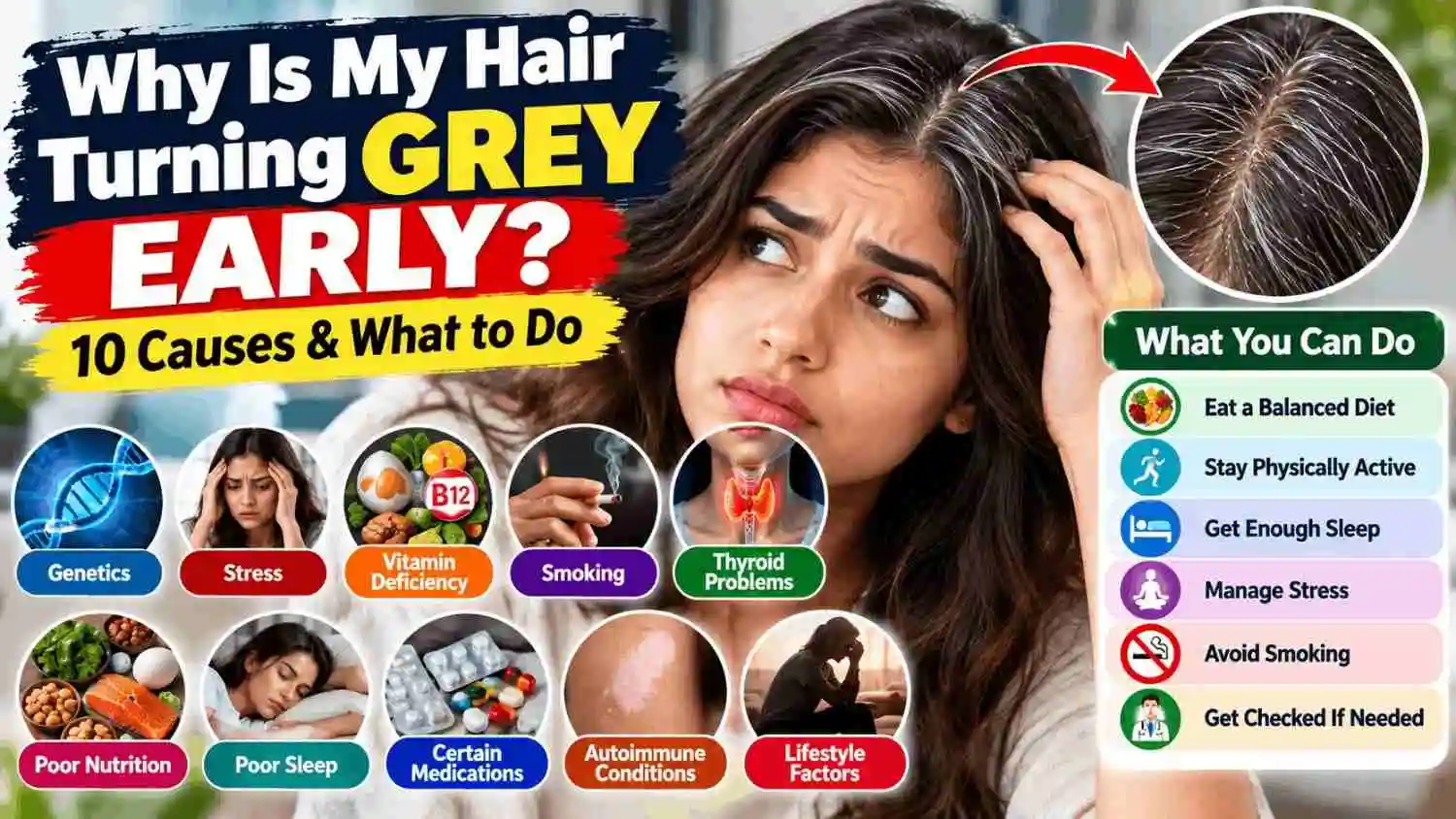
- Why Is My Hair Turning Grey Early? 10 Causes & What to Do
- Stress Management: Simple Ways to Support Your Mental Well-Being
- Healthy Sleep: How Much Sleep Do You Need Every Night?
- What Is a Balanced Diet? A Simple Guide to Healthy Eating
- Physical Activity: Simple Ways to Stay Active and Support Your Health
- Daily Hydration: How Much Water Should You Drink Every Day?
References
- American Academy of Dermatology — Do You Have Hair Loss or Hair Shedding?
- American Academy of Dermatology — Hair Loss: Overview
- American Academy of Dermatology — Hair Loss: Who Gets and Causes
- American Academy of Dermatology — Hair Loss: Diagnosis and Treatment
- American Academy of Dermatology — Hair Loss: Tips for Managing
- American Academy of Dermatology — Male Pattern Hair Loss
- MedlinePlus — Hair Loss
- NHS — Hair Loss
Health Disclaimer
This article is provided for general health awareness and educational purposes only. It is not intended to diagnose, treat, cure, or prevent any medical condition. Hair loss can have many possible causes, and a qualified healthcare professional should evaluate persistent, sudden, severe, patchy, or unexplained hair loss.
We share short 3D animated health videos on social media. Follow us to see them first.
This article is for general information only and is not medical advice. Please talk to a doctor about your own health. Read our disclaimer.

Written by vvk456
General health information only. Not a substitute for medical advice.